

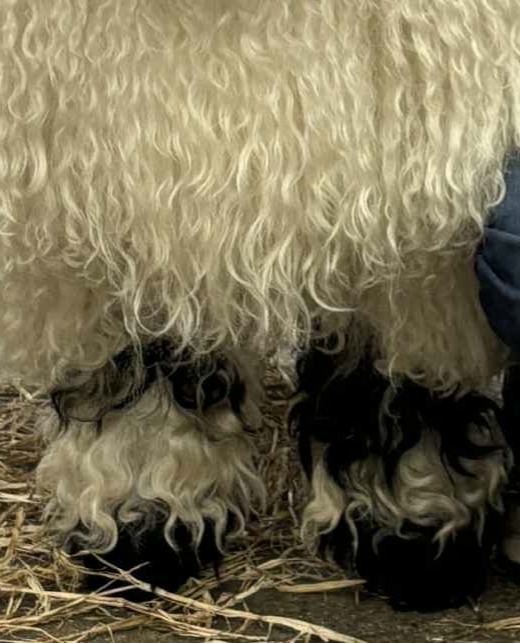
The Importance of Leg Wool in Valais Blacknose Sheep
Understanding why leg wool is one of the most critical traits separating exceptional animals from average ones
In This Article
The Valais Blacknose sheep is renowned for its distinctive appearance—the striking black face and ears contrasted against a cloud of white wool that, in an ideal specimen, envelops the animal from head to hoof. While many admirers focus on the breed's charming facial markings and spiral horns, experienced breeders and judges understand that leg wool is one of the most critical traits separating exceptional animals from average ones.
Why Leg Wool Matters
In the Swiss Alps where the Valais Blacknose originated, the breed developed its characteristic heavy fleece as protection against harsh mountain winters. This adaptation wasn't selective about body parts—the sheep needed insulation everywhere, including their legs. The result is a breed standard that calls for wool coverage extending fully down all four legs to the hooves.
Leg wool serves as a reliable indicator of overall fleece quality and genetic strength. An animal that produces dense, well-structured wool on its legs typically carries the genetics for superior wool production across its entire body. Conversely, sparse or absent leg wool often signals weaknesses in fleece genetics that may appear elsewhere in the animal or its offspring.
Uniformity as a Standard of Excellence
Beyond simply having wool on the legs, show-quality Valais Blacknose sheep must demonstrate uniformity of fleece across their entire body. This means the wool on the legs should match the density, texture, and staple structure found on the barrel, neck, and hindquarters. Judges look for a seamless, cohesive appearance—as though the sheep is wearing a single, perfectly fitted wool coat rather than a patchwork of varying qualities.
Uniformity reflects genetic consistency. When wool grows evenly across all body regions, it suggests the animal's genetics are reliably expressing the desired fleece characteristics. This predictability matters enormously for breeding programs, as uniform parents are more likely to produce uniform offspring.
Common Faults in Leg Wool
Several issues can diminish an animal's competitiveness in the show ring. Bare or sparse lower legs represent perhaps the most significant fault. Some sheep develop adequate wool on the upper leg but show thinning or complete absence below the knee and hock. This pattern suggests the animal lacks the genetic drive for complete wool coverage.
Inconsistent texture occurs when leg wool differs markedly from body wool—perhaps appearing coarser, finer, or with a different crimp pattern. Even with full coverage, this inconsistency detracts from the ideal uniform presentation.
Poor structure manifests as leg wool that hangs limply, mats easily, or lacks the distinctive spiral curl prized in the breed. Quality leg wool should exhibit the same defined staple formation found elsewhere on the body.
Evaluating Leg Wool in Your Flock
When assessing your own animals or considering purchases, examine the legs carefully. Part the wool to observe density near the skin. Check that coverage extends fully to the coronary band above the hoof. Compare the wool's character on the legs to that on the shoulder and hip—they should be indistinguishable in quality.
Young lambs can be somewhat misleading, as leg wool often fills in as animals mature. However, lambs showing strong leg wool early typically develop into adults with superior coverage. Those with bare legs at a young age rarely improve dramatically with age.
Breeding for Improvement
Improving leg wool in a breeding program requires patience and careful selection. Prioritize rams with exceptional, uniform leg coverage, as the ram influences far more offspring than any single ewe. When evaluating potential breeding stock, consider leg wool a non-negotiable trait rather than something that can be overlooked in favor of other qualities.
It's worth noting that leg wool is highly heritable. Crossing animals with poor leg coverage rarely produces offspring with significant improvement, even when the other parent excels in this trait. Building a flock known for uniform, complete fleece coverage requires consistent culling of animals that fail to meet the standard, regardless of their other merits.
The Bigger Picture
Leg wool ultimately represents something larger than a single trait—it reflects the breed's heritage and purpose. The Valais Blacknose was shaped by centuries of Alpine conditions into an animal wrapped entirely in protective fleece. Preserving this characteristic honors the breed's history while maintaining the qualities that make these sheep so visually distinctive.
For breeders serious about show success and producing animals true to type, leg wool and overall fleece uniformity deserve the same attention given to markings, conformation, and horn development. The complete package—that seamless cloud of wool from nose to toes—is what makes a Valais Blacknose truly exceptional.
Questions About Breed Standards?
Our team is here to help with any questions about Valais Blacknose sheep.
Contact Us