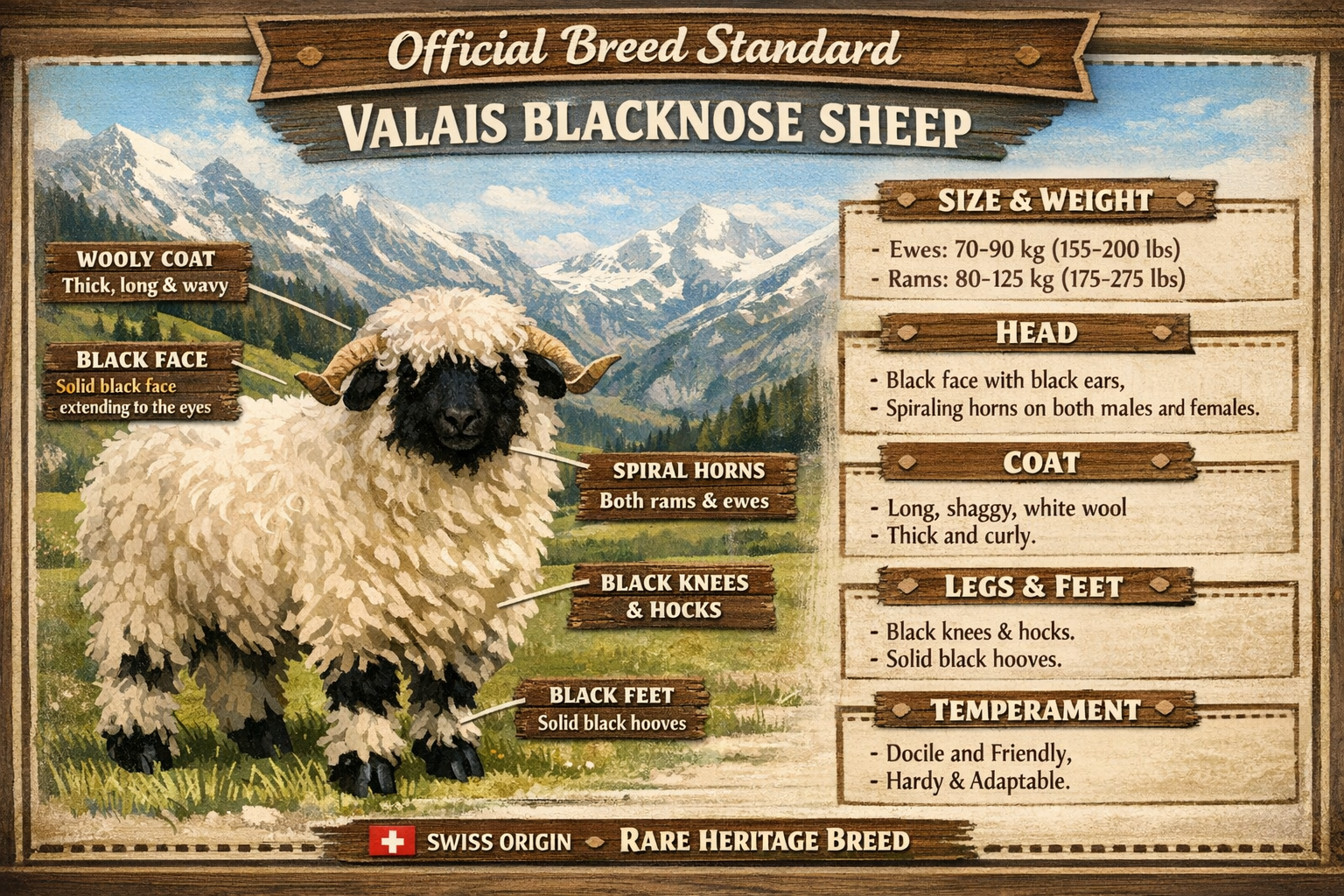
The Valais Blacknose Sheep Association of North America (VBSANA), Valais Blacknose Sheep Society (VBSS), and the Valais Blacknose International Sheep Breeder Association & Registry (VBISBAR) support this breed standard information and judging guidelines, consistent with the Swiss Breed Standard.
Important: This is primarily a wool breed. Full horns, full wool and tails are important. Sheep can be washed but not fitted/clipped/blocked for shows. Ideally, wool should be 5-6", but can be shown with less.
1 Appearance
Color Features
No brown or grayish color
Black nose to the center of the head
Black encompassing the eye area connecting with the black of the nose, no gap
Black ears – black should meet the white of the head
Black hooves and ankle area ('black socks')
Black spots on knees and hocks (spots can be non-symmetrical). Knee spots need a white line of separation between knee spots and ankle area
Females are to have a black spot under the tail with at least a pencil-width gap of white on the visual side of the tail
Males must not have a black spot under their tail
Males' scrotum may be black, but the black must not spread upward above the scrotum
Head & Neck
Well proportioned, compact head
Roman nose, wide mouth, broad forehead
Pronounced, regal head shape in ram (mature rams often develop protuberance behind horn base)
Short, straight well-muscled neck
Horns
Spiral outward from head, horizontally away from cheeks (you should always be able to fit a flat hand comfortably between the horn and cheek)
Black stripes in the horns are acceptable, just no black wool at base
Male horns are thicker, spiral forward, down, and then curl out to the side
Female horns are thinner, spiral slightly down, and then curl out to the side
2 Conformation
Chest, Shoulder & Withers
Wide, deep chest area
Shoulders line naturally with neck and chest
Well-spaced, wide withers
Rib cage curvature is well proportioned and rounded
Back & Loin
Long, straight top line
Wide back and loin
Pelvis, Abdomen & Hindquarters
Medium sized belly with small belly hollows/pits
Wide and medium-length pelvis
Well-muscled hindquarters
Limbs & Gait
Strong, sure footed with solid hoof deportment
Legs are not bow legged or knock-kneed
Legs are to be more under the sheep than to the side
Slight hock angulations with short, strong pasterns (45-degree angle)
Spacious, sure footed and wide legged gait
Even and stable movement, mobile with ease
Size Standards (over two years)
Measurement
Female
Male
Withers Height
23.3-30.7 in
29.5-32.7 in
Weight
150-200 lb
175-275 lb
3 Wool
Fleece in lambs is soft to touch but becomes coarser as the sheep matures
The Swiss grade approximately equates to 28-38 microns depending on age and gender
Fiber diameter is generally finest in lambs and coarsest in adult males
Staple length is 4-6 inches based on approximately six months' growth
Recommended to be shorn twice a year
Wool on legs is thick and full
Wool on head is natural and long
Some black hairs/fibers are tolerated on the neck area (females only; in males up to 18 months this is a fault)
Wool is double coated
Approximate Fleece Weight (six months growth)
Category
Weight
Lambs
2.2-3.3 lbs
Ewes
2.5-6.6 lbs
Rams
5.5-6 lbs
Major Flaws
Incisor teeth not in contact or correct position with dental pad (overbite or underbite) up to 18 months of age
Weak and/or fallen pasterns
Stunted growth
Only one testicle present
Scrotal hernia
Black body spots on the main body area (males)
Black spots under the tail on males
Markings missing from knees, hocks or head
Kemp and/or tender fibers in wool
Excessive guard hairs
Large amounts of felting within the wool
Spitti (Multi-Color): On occasion a purebred Valais Blacknose may produce offspring marked in reverse color/markings. No Spitti should place above a correctly marked sheep unless conformation is not correct on correctly marked sheep. Spitti and over-marked sheep should be in a class of their own or natural colored wool classes. Spitti rams should not be kept for breeding.
Fitting Notice: Blocking is not permitted and considered a disqualification. Leg wool should be similar in length to body wool. No docking of tails shorter than three fingers above hocks. Halters are not permitted as they do not fit the roman nose and pose a safety risk. Use a collar & lead instead.